

Unpacking Daniel Roth’s Most Unusual Creation: The “Lego Bracelet”
Updated: Aug 1
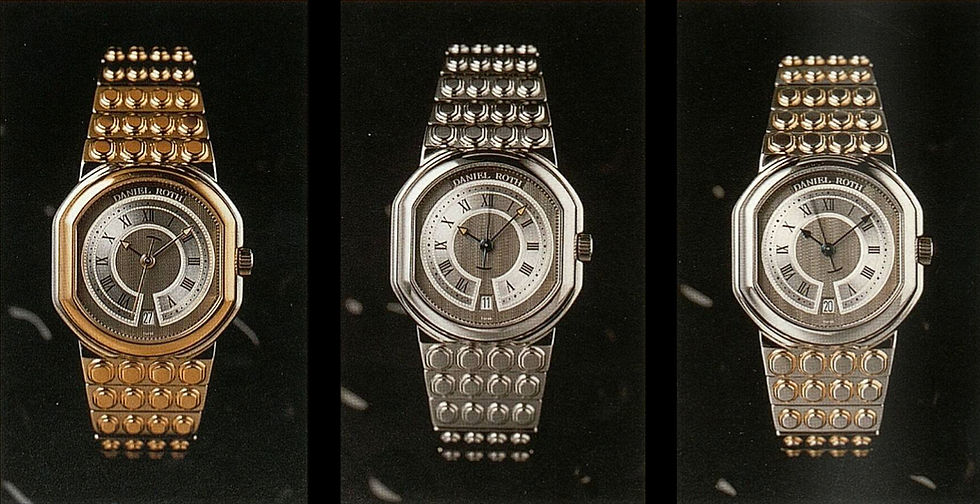
I still remember the first time I encountered a "Lego bracelet”. I could hardly believe a watch like this existed, let alone one bearing the Daniel Roth name. The design was so unlike anything in his catalog, that it immediately provoked a question: what could have pushed Roth to stray so boldly from his own aesthetic language? After all, Daniel Roth is synonymous with sleek, classical, ellipsocurvex cases in precious metals, paired with understated leather straps. But a stainless steel watch with integrated bracelet? My first reaction was simple: this is wild.
Many collectors, even today, tend to dismiss all-steel Daniel Roth models, assuming they were all conceived during a period when the master’s influence was fading. But that assumption falls apart under scrutiny. The Le Sentier Sports patent was filed in late 1993, placing its development squarely in 1991–1992—the heart of what collectors now call Roth’s Classic Period, the era that produced his most coveted and enduring creations.
US Patent D361,281 filed in Jan 1994 with a Foreign Priority Date of Sep 1993 Front and back perspective views of D361,281. Patent WO-D030275-001 filed Sep. 14 1993 showing early prototype with no-date dial. Patent WO-D030825-001 filed Nov 1993 showing another prototype with strap option.
Seen in that light, the Le Sentier Sports and especially its remarkable bracelet—stands out as one of the most daring and technically ambitious designs of his early years. It speaks to the atelier’s resilience and Roth’s determination to stay relevant amid the rapidly shifting currents of the 90s. But, let’s hear it from the Master himself instead:
"It all began with our first sports watch made entirely of steel. This was a very expensive watch for its category because the bracelet was very difficult to create, to machine and to mount. From the beginning we have treated steel as a material of the highest nobility. We work with steel as we work with gold, using as much care to get an identical quality. And our steel cases are a devil to make."[1] -Daniel Roth
The Prologue

In 1988, Daniel Roth set out on his own, establishing a workshop in Le Sentier. It was a bold decision in an era when independent watchmaking was still the exception rather than the rule. Daniel Roth’s early work was defined by a disciplined blend of classical watchmaking and quiet originality. Drawing on his experience at Breguet and Audemars Piguet, he favored traditional complications, hand-finished movements, and restrained proportions, while introducing a distinctive double-ellipse case and a sober architectural aesthetic.
This aesthetic, however, stood in contrast to some of Roth’s early commissioned works, where a greater expressive approach and perhaps a hint of exuberance was allowed, particularly in his bracelet design. A standout example is the Tourbillon Double Face Skeleton Ref. 187S, produced in 1991 for the Zürich jeweler Türler Schmuck & Uhren, a piece that reveals a more experimental side of Roth’s early output.

The Daniel Roth Reference 187S stands as a rare creation, with its architecturally complex bracelet made of skeletonized Ellipsocurvex links. More than an isolated design exercise, the bracelet appears to offer an early blueprint for what would later become the “Lego Bracelet.” Close examination suggests that Roth took inspiration from this very reference when developing the Le Sentier Sports, his first serially produced watch in stainless steel and his first integrated bracelet produced at scale.
Le Sentier Sports Gen 1

At Basel ’94, Daniel Roth unveiled the “Sports” line, distinguished by its astonishing metal bracelet design. The case maintained the double-ellipse silhouette recognizable to collectors, with measurements of 38 x 35 mm and just 7.8 mm thick. The Le Sentier Sports arrived in four configurations: full gold, full steel, and two bicolour combinations that inverted gold and steel elements. [2] Each example was fitted with a water resistant case to 30 meters and sapphire crystal on both sides.
On the dial, Roth stayed close to the language that defined his early work: a crisp pinstripe pattern, Roman numerals on a chapter ring, and arrow-shaped hands accompanied by a sweeping, anchor-inspired seconds hand. The trapezoid-shaped date aperture at six o’clock offered a subtle departure from his usual small-seconds subdial, with a “Swiss” marking just below it.
Inside, Roth selected nothing short of a modern classic: the ultra-thin Jaeger-LeCoultre Calibre 889/1, an ébauche also trusted by Vacheron Constantin and Audemars Piguet. The watch was priced at 11.900 Swiss francs for the all-steel version, the two tones for 14.500 Swiss francs and 32.000 Swiss francs for the all gold version.[3]

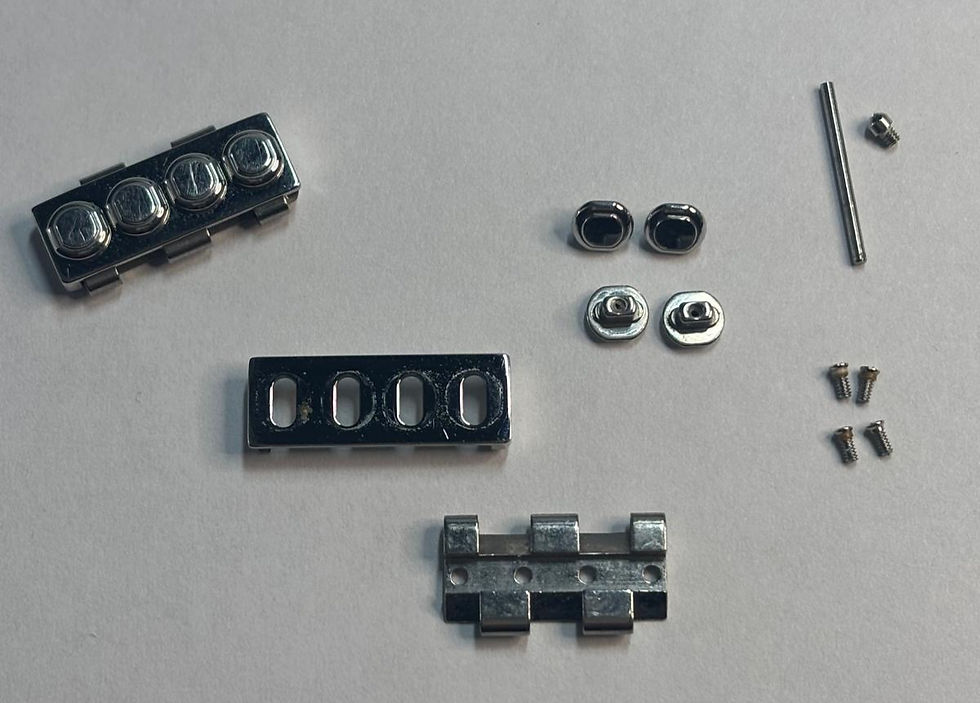
The “Lego” bracelet, however, remains the undeniable star. A design feat that ranks among the most daring and distinctive of its era. As Roth himself suggested, they were “a real devil to make,” and he wasn’t exaggerating. Just think about the task: a polished bracelet with openworked links, with tiny bits of ellipsocurvex shapes machined individually, in stainless steel—a yet unfashionable and notoriously unforgiving material few dared to touch at the time. It was the kind of challenge most watchmakers would politely decline.
Even now, it’s hard to fathom the sheer commitment behind it and the willingness to embrace a near impossible design. The result? A bracelet that’s every bit as daring as those industry icons. Featuring no fewer than 356 individually assembled components. Its design transformed a functional bracelet into a statement of technical virtuosity and art.
Le Sentier Sports Gen 2

Fuelled by extraordinary regional demand, Singapore became a key player for the Swiss luxury sector in the mid-1990s. Swiss watch exports to the city-state soared by 65.4% between 1991 and 1994, peaking at SF 494.2 million.[4]
This wave of prosperity directly influenced the trajectory of the young Daniel Roth brand. After navigating a period of financial strain, Roth sold a significant stake in his company to The Hour Glass Group by the end of 1994. The Singapore-based luxury retailer had been a long time distributor for the brand in the Asian market. This partnership marked the beginning of what collectors now refer to as The Hour Glass Period, a moment that would shape the Daniel Roth’s next chapter.
Under this new business arrangement, Roth introduced in 1995 the second generation of the Le Sentier Sports reference S177ST-B.[5] The core design remained intact, with minimal updates made to the dial and movement. Tritium-lit circular hour markers were added to the dial layout, and the color options expanded beyond the original gray to include black and the now coveted salmon or copper dial.

More significant was the shift inside the case. For this second generation, Roth used the Caliber 0157, derived from the Girard-Perregaux 3100 movement. This is a movement well regarded in high horology and used in models such as the Vacheron Constantin Overseas (first Generation) and the Girard-Perregaux Laureato.
The ultra-thin GP 3100 is a self-winding movement that beats at 21,600 vph with approximately 45 hours of power reserve, two-part rotor with peripheral gold-plated weight. The movement was hand finished with anglage, Côtes de Genève and adjusted by Roth craftsmen for a total of approximately 30 hours of work. The rotor was signed with Daniel Roth’s name in gold.
Another significant change worth mentioning is that the price of the all-steel model was lowered to 10.800 Swiss francs, which in 1995 would have been roughly 9,150 USD (19,575 in 2025 dollars, adjusted for inflation).

Early advertisement shown in italian magazine Another advertisement shown in magazine Europa Star
Beginning of color dials

In response to shifting tastes in the mid-90s, Daniel Roth introduced his first series watches with laquered color dials in 1996. The debut came with the new line of sport automatic chronographs, which were available in a number of primary color dials and their matching aligator straps. These newly colors were described by Daniel Roth as lemon yellow, cherry red, midnight blue and prairie green.[6] Of these, we know that the green, yellow and red dials were produced in a very limited number. Chronographs with this color configurations are rarely seen available on the market for sale.

It’s also possible that, during this period, Daniel Roth experimented with expanding these dial colors to the Le Sentier Sports line. At least one example has surfaced on the market with a green dial. While this rare variation could not be definitively placed in this time period with the information currently available, its design and technical characteristics fully align with the second generation, suggesting that such color execution likely originated in this era.
In this example, the dial layout mirrors that of earlier models, retaining the Swiss only dial with silvered Roman numerals and circular tritium hour markers. The only departure is the substitution of the traditional engine-turned dial for a striking green finish. Beyond this, the movement (GP 3100), and bracelet configuration remain consistent with the original Le Sentier Sports design.
Daniel Roth Le Sentier Sports Timeline

Le Sentier Sports Gen 3

Unfortunately, trouble arrived almost as soon as The Hour Glass took over Daniel Roth. The Singaporean market softened, Swiss watch sales tumbled, and by 1996 the sector was already down 16.4% from 1994.[3] Then came the 1997 Asian Financial Crisis, which pushed an already fragile market into deeper turmoil.
In an effort to speed up turnover, the brand increased its production of steel watches. As Daniel Roth explained in a 1997 Europa Star interview, steel models had grown to represent 60–70% of their total production of all watches (including precious metals), which is estimated at roughly 1,000 pieces a year.[1]
Amid this difficult economic climate—Daniel Roth unveiled the final generation of Le Sentier Sports models, introducing in 1997 the most dramatic changes yet in both movement and design. A key identifier of these third series was the addition of the “Swiss Made” designation at the foot of the dial. In addition, the trapezoid-shaped date window is now rounder with curved edges.
Aside from these minor changes, the dial layout remained consistent with the first two generations, featuring Roman numerals, tritium hour markers, and an engine‑turned finish. Dial colors with this Gen 3 configuration included gray, black, salmon and for the first time white.[7] (Gen 3 lacquered color dials were added later, with a different dial configuration.)
While the dial layout remained mostly the same, the case size and the bracelet underwent the most consequential transformation. The case size was reduced to 34.5 mm x 31.5 mm and although the overall “Lego” aesthetic of the bracelet was preserved, the construction was compromised and changed entirely. The links became solid, uniform blocks, abandoning the earlier openworked architecture. In this new bracelet version, the small ellipsocurvex elements, are now integrated into the links and were no longer removable, separate units held by screws.


Gen 2 (left) and Gen 3 (right) case size comparison. Note the rounder date window opening in the Gen 3. (Photo source: Ben Watches Instagram)
This third generation was powered by a modified Frédéric Piguet movement Caliber 9.51. The FP Cal. 9.51 is an ultra-flat 19-jeweled automatic winding movement with approximately 40 hours of power reserve, beating at 21,600 vph. The movement was decorated with similar fashion as the prior version (Côtes de Genève and anglage) , with the exception that the rotor no longer had the gold-plated weight and it was now signed with a Daniel Roth curved logo.
This movement selection proves exceptional, keeping this Le Sentier Sports generation firmly anchored to the rigorous quality that distinguished Daniel Roth’s creations. The price of the Gen 3 all-steel model in year 2000 was listed at 8,750 ITL (6.9 Swiss francs).[8]

Swiss Made Color Dials
By the end of 1998, The Hour Glass was hampered by production shortfalls that created a backlog and drove Daniel Roth and Gérald Genta (then under majority ownership of The Hour Glass following the 1996 acquisition) to a combined loss of 5.9 million Swiss francs.[9]
In 1999, seeking to restructure, the company formed La Manufacture de Haute Horlogerie. Born from the alliance of Gérald Genta and Daniel Roth, the venture brought both maisons under one modernized roof in Le Sentier - yet each brand aimed to keep its own name and creative path.[10]
However, this new merger barely had time to settle before it ended. In 2000, The Bvlgari Group reached an agreement with The Hour Glass to acquire both Gérald Genta SA and Daniel Roth SA outright. The deal totaled 37.6 million Swiss francs, based on the book value of net assets as of June 30, 2000.[11]
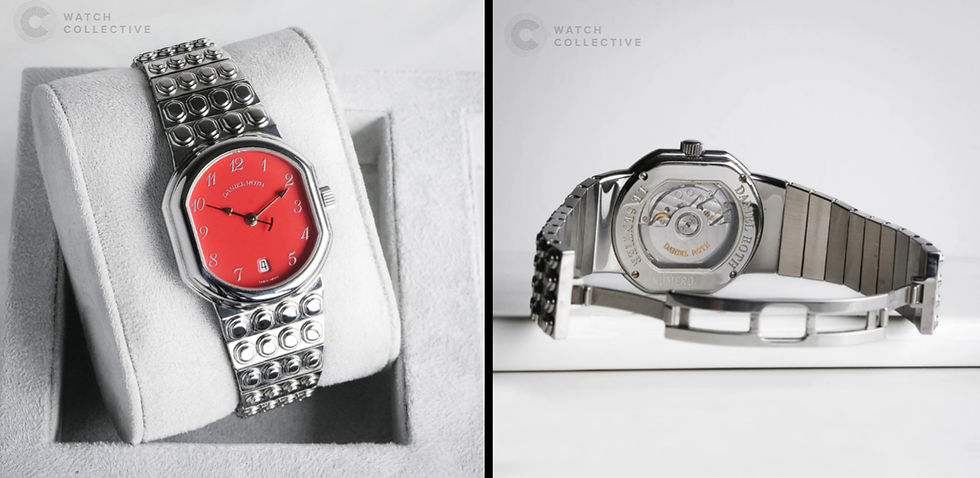
This era of Daniel Roth will be know by collectors as the Bvlgari Period, which will foster the advancement of the Le Sentier Sports “Swiss Made” laquered color dials. Similar to the chronographs with color dials, these watches were advertised in 2000 in blue, red (coral), green and yellow.[8]


These dials also presented a significant departure from the Daniel Roth dial aestethics observed during the first and second generations of Le Sentier Sports watches. Roman numerals were replaced by Breguet numerals, minute and hour markers removed, the circular tritium indexes above the numerals also removed and the tritium-filled tips were removed from the arrow-shaped hands.
This resulted in a new aesthetic characterized by simplicity, minimal and legible dials. The bracelet design and movement (FP 9.51), however, remain the same as in the third generation.
The extreme scarcity of these color dial configurations on the open market leads to conclude that production numbers were exceptionally small. With so few examples ever surfacing for sale, the rarity of these specific dials is significantly amplified.
Recent market activity confirms the presence of coral red, green, and yellow examples. By contrast, the blue variant remains an outlier, having surfaced only in strap form, with no known “Lego Bracelet” examples documented so far. This scarcity convert these lacquered color dials into perhaps a truly exceptional opportunity for the discerning collector.
Other Variations Known to the Market
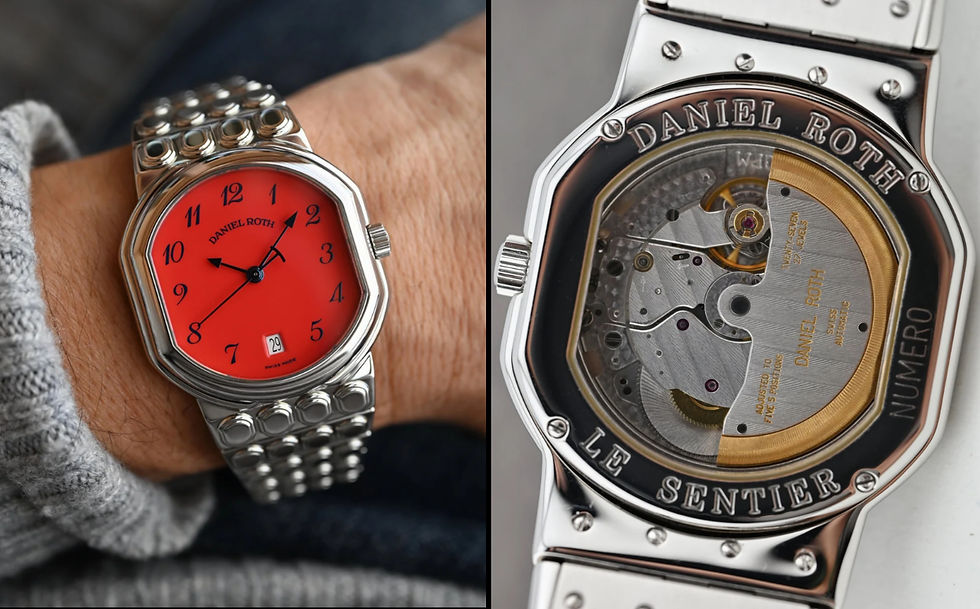
Although the Le Sentier Sports can broadly be classified into the three evolutionary generations above, recently documented examples suggest that these transitions were not always clear-cut. Certain watches combine characteristics traditionally associated with different generations, indicating that Daniel Roth's production evolved progressively rather than through abrupt design changes.
While the third generation is generally recognized by its solid-link bracelet and "Swiss Made" dial, at least one recently surfaced example challenges a rigid generational classification. The watch combines the Girard-Perregaux GP3100 movement and hollow-link "Lego" bracelet associated with the second generation with a glossy coral lacquer dial featuring painted Breguet numerals.
This unusual configuration may represent a transitional execution bridging the second and third generations. Alternatively, it could suggest that colorful lacquer dials continued to be offered across multiple case sizes and movement configurations for a longer period than previously documented. Until additional examples emerge, both interpretations remain plausible.
Rather than undermining the proposed classification, this discovery reinforces the notion that the Le Sentier Sports evolved through a gradual process of refinement. As is often the case in independent watchmaking, design and technical changes were likely introduced incrementally, resulting in periods of overlap that defy rigid generational boundaries.
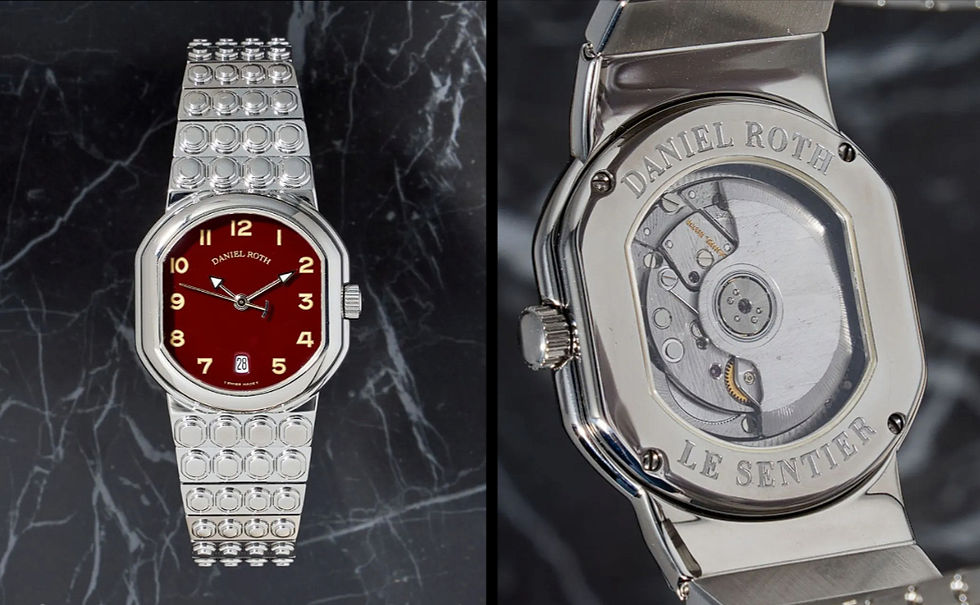
Rarer still is this less known burgundy dial variant, believed to have emerged possibly as one of the final iterations of the Le Sentier Sports line. It features tritium filled Arabic numerals, the distinctive arrow-shaped hands with tritium lume and a “T Swiss Made T” designation at the foot of the dial.
Turn the case over and a Frédéric Piguet 9.51 reveals itself, fitted with an oddly unsigned rotor. The absence of branding in the rotor and the unnumbered case suggests that this piece may have been a special request or even an early prototype (potentially from the Hour Glass or Bvlgari transition years) produced perhaps as part of an effort to extend the lifespan of the Le Sentier Sports line with fresh dial configurations.

What remains indisputable is that the Le Sentier Sports “Lego bracelet” stands as one of Daniel Roth’s most ambitious and visionary creations. Its unconventional form challenged the boundaries of what a Roth watch could be.
It defied expectations then, and it deserves renewed attention now. With LVMH guiding the brand’s revival, there remains hope that this singular design could one day return with modern craftsmanship yet unmistakably faithful to Roth’s original vision.
In the meantime, the real thrill lies in the unknown. How many other configurations might still be hiding in private drawers or long forgotten archives? Each discovery has the potential to rewrite a small chapter of Daniel Roth’s history, shedding fresh light on a brand whose legacy is still being pieced together. What other clues wait to be unearthed and what stories will they reveal about the evolution of Le Sentier Sports?
Only time will tell.
References
[1] "Interview with Mr. Daniel Roth." Europa Star Europe Issue 221, Mar. 1997, p. 49.
[2] "New Start for Daniel Roth." Europa Star Europe Issue 205, 1994, p. 90.
[3] "Daniel Roth." Le Collezioni Orologi Meccanici Piu' Prestigiosi Del Mondo: Annuario 1995, Dec. 1994, p. 167
[4] Thompson, Joe. "Swiss Watch Exports: Who's Hot and Who's Not." Europa Star Europe Issue 222, Apr. 1997, p. 335.
[5] "Daniel Roth." Le Collezioni Orologi Meccanici Piu' Prestigiosi Del Mondo: Annuario 1996, Dec. 1995, p. 188.
[6] "Daniel Roth's New Authomatic Chronograph." Europa Star Europe Issue 219, p. 24.
[7] "Daniel Roth." Le Collezioni Orologi Meccanici Piu' Prestigiosi Del Mondo: Annuario 1997, Dec. 1996, p. 166.
[8] "Daniel Roth." Le Collezioni Orologi Meccanici Piu' Prestigiosi Del Mondo: Annuario 2000, Mar. 2000, p. 188.
[9] Lakin, Malcolm. "The Hour Glass Sows Its Sands." Europa Star Europe Issue 236, p. 55.
[10] "The Association of Genta and Roth." Europa Star Europe Issue 232, Jan. 1999, p. 81.
[11] "Bulgari To Acquire Gerald Genta And Daniel Roth." Fédération De L'industrie Horlogère Suisse, 5 Jul. 2000, www.fhs.swiss/eng/2000-07-05_44.html.


This might be the coolest weird bracelet ever made. Great research!
Wonderful read, very informative! Love the timeline!