

The Hidden Evolution of Blancpain’s Gay Frères Bracelets
- Xavier Marti
- May 24
- 9 min read
Updated: 3 days ago

Bracelets are one of the most fascinating yet overlooked aspects of watchmaking, often relegated to the background in discussions about a watch’s importance. Ironically, without the bracelet (or strap), the wristwatch itself would never have existed and we might still be carrying pocket watches today. With that in mind, one could argue that the bracelet and its design are among the most important elements of a watch. The bracelet is the watch’s primary point of contact with its wearer, directly influencing comfort and, ultimately, the watch’s practicality and usability.
The bracelet is not only one of the most important functional components of a watch, but also one of its most visually defining features. Think of the great designers and the creations they introduced to the world of horology. Gérald Genta, Jörg Hysek, and others created what we now consider iconic bracelet designs, particularly within the integrated-bracelet sports watch segment whose aesthetic today commands a significant premium. The logic behind these bracelets, however, is inseparable from the watches themselves, as their design language is directly tied to the identity of the watch.

Removable bracelets, have also achieved a legendary status worthy of discussion. Take, for example, the Wellendorff bracelets created for A. Lange & Söhne during the 1990s. At the time, they were a relatively unpopular option among collectors purchasing these watches. Today, however, these bracelets have become highly sought after and trade at substantial premiums on the secondary market.
And yet, Blancpain’s Gay Frères bracelets do not seem to receive the same level of recognition when discussing rarity, importance, and desirability, despite the remarkable context in which they were created. While it is true that the Wellendorff bracelets are far rarer and occupy a different tier of exclusivity, the Gay Frères bracelets made for Blancpain remain historically significant in their own right when one considers the period: the rebirth of Blancpain during the aftermath of the Quartz Crisis. Therefore, before fully exploring the evolution of Blancpain’s Gay Frères bracelets, it is important to first understand the origins of the Villeret collection and the beginning of Blancpain’s revival.
The Rebirth of Blancpain
During the early 1980s, mechanical watchmaking was still recovering from the devastation of the Quartz Crisis. Many historic Swiss maisons had either disappeared or shifted almost entirely toward quartz production. Blancpain, however, chose a radically different path. Revived in 1983 under Jean-Claude Biver and Jacques Piguet, the brand returned with a bold philosophy:
“Since 1735, there has never been a quartz Blancpain watch, and there never will be.”
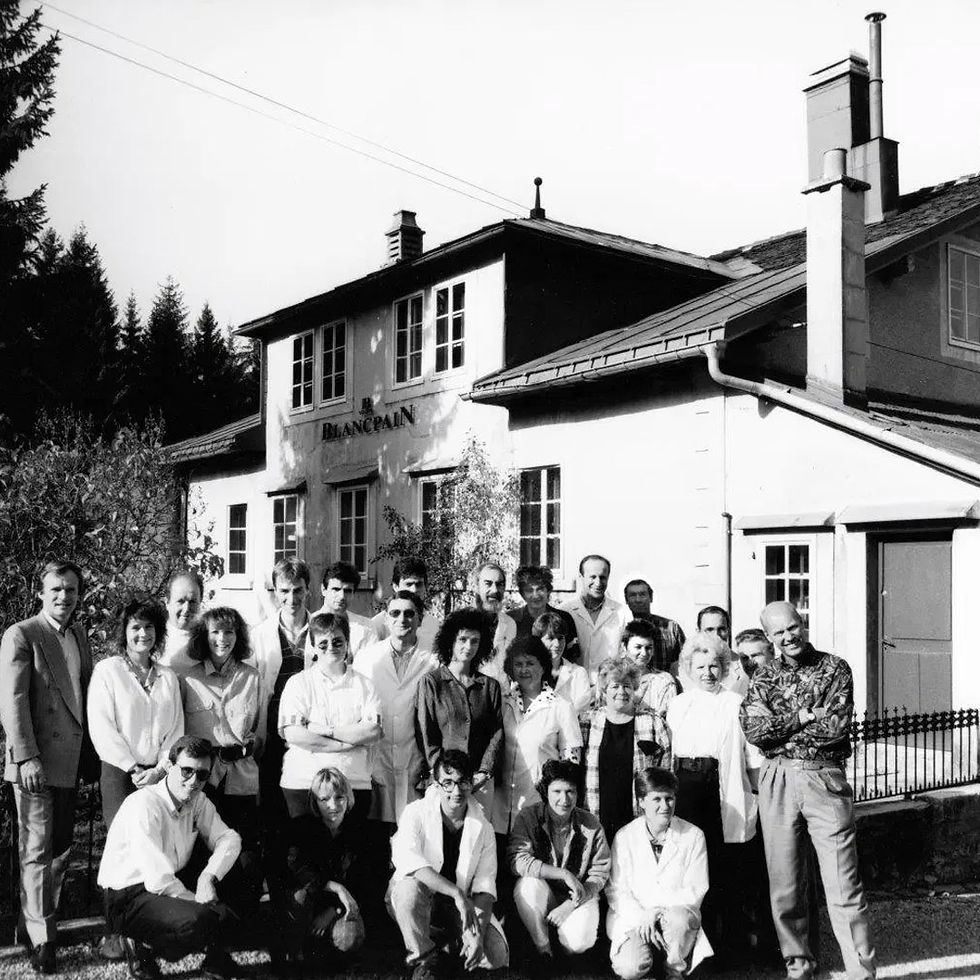
The watches that emerged during this first revival period were not only important mechanically, they were also experimental. Produced in small quantities and during a time of rapid growth, early Blancpain references reveal a fascinating level of variation that today remains largely undocumented. Among the most interesting examples is the first of the Masterpieces, the Villeret Triple Calendar and their references 6501, 6511, and 6595.
Villeret Ref. 6501

While the ref. 6595 is often regarded as the first of Blancpain’s revival-era masterpieces, archival evidence shows that distinction actually belong to the earlier Villeret Triple Calendar ref. 6501. This is further supported by a recent letter from Blancpain, which confirms that the ref. 6501 was the first model introduced following the brand's revival. Introduced in 1983, the 6501 embodied the ultra-thin classical direction Blancpain would become known for throughout the decade.
The 6501 featured a dial with a warm silver sunburst outer section paired with a soft cream-colored center. Combined with the printed black Roman numerals, recessed calendar apertures, and deep blue moonphase display with the now iconic stylized face, the watch feels noticeably warmer and more experimental than the cleaner and more uniform aesthetic typically associated with the 6595. The watch was offered in full gold, two-tone and all-steel with options to buy on a leather strap or with the Gay Feres bracelet.
The watch housed Calibre 64-1, a hand-wound ultra-thin movement finished and modified by Piguet which was based on the Peseux 7001 architecture. The Peseux 7001 featured 17 jewels and operated at a rate of 21,600 vibrations per hour (3Hz frequency). It employed Incabloc for its anti-shock system, with approximately a 42-hour power reserve. In many ways, the 6501 established the blueprint for Blancpain’s revival: thin proportions, traditional complications, and understated elegance.
Villeret Ref. 6511

The ref. 6511 followed shortly after and introduced an automatic movement configuration while maintaining much of the same visual identity. The main identifier of the 6511 as opposed to the 6501 is the inclusion of the cursive text “automatic” on the dial just below the Blancpain logo as seen on its sucessor the 6595. Unlike the later and more regularized 6595, the 6511 appears to belong to an earlier phase where Blancpain was still refining its automatic calendar movement platform.

The caliber used in the Blancpain 6511 was derived from the Omega cal. 711, a slim automatic movement developed during the late 1960s and 1970s. Known for its compact construction and elegant proportions, the 711 served as a practical foundation for Blancpain’s early revival-era calendar watches before the manufacture transitioned toward the Frédéric Piguet-based calibers seen in the 6595.
Most likely, the Frédéric Piguet automatic movement had not yet been fully developed or industrialized when the 6511 was introduced, leading Blancpain to rely on an existing ultra-thin ébauche during this transitional phase. While Blancpain modified and refined the movement for its own use, the 6511’s caliber reflects the experimental nature of the brand’s early revival years, when external movements were being adapted as the reborn manufacture rebuilt its mechanical identity.
Villeret Ref. 6595

Shortly afterward, in 1984, Blancpain introduced ref. 6501 and 6511 in white dial configuration and in 1987 the ref. 6595, the model that would ultimately become the most widely recognized expression of the revival-era triple calendar.
The white dial configuration features a cleaner and more restrained execution with sharper printing, applied roman numerals and an uniform clean dial with white tones. The result is a dial that feels more modern, refined, and cohesive while still preserving the ultra thin classical elegance that defined early revival-era Blancpain.
The 6595 was powered by the Frédéric Piguet 951 automatic movement, the reference represented Blancpain’s increasingly refined and industrialized direction during the mid-1980s. The FP 951 would go on to become one of the defining calibers of Blancpain’s revival era thanks to its slim architecture, reliability, and suitability for complicated calendar watches.

At the time, the bracelets were rarely offered because most Villeret watches in the late 1980s–1990s were sold on straps. Gold bracelets were slightly more common because they matched the luxury cases and were a popular upgrade. Steel bracelets and diamond set bracelets were likely mostly special orders for collectors who wanted those specific configurations. For a more detailed overview of the 6595 and breakdown of its variations by reference numbers, I highly recommend visiting Watch Brothers London website.
For the construction and design of the Villeret bracelets, Blancpain chose none other than one of the greatest bracelet makers of its era: Gay Frères.
The Bracelet Maker

Founded in Geneva in 1835, Gay Frères became one of the most important bracelet manufacturers in Swiss watchmaking history, supplying bracelets to some of the industry’s most prestigious maisons throughout the 20th century, including Rolex, Patek Philippe, Audemars Piguet, Vacheron Constantin, and of course Blancpain. Renowned for its high-quality metalwork, jewelry craftsmanship, complex integrated bracelet designs, and refined finishing techniques, the company established itself by the 1970s and 1980s as the benchmark for luxury bracelet production, creating iconic designs such as the Rolex Oyster and Zenith ladder bracelets, as well as numerous integrated sports-watch bracelets during the post-quartz era.
During Blancpain’s early revival period in the 1980s, Gay Frères produced the intricate bracelets fitted to references such as the 6501, 6511, and 6595—bracelets that today reveal a surprisingly complex evolution in construction, and finishing as the reborn manufacture gradually transitioned from experimental low-volume production to a more industrial phase.

The bracelet construction was built around brushed flat outer links that are sharply chamfered, contrasted by a pair of narrow central cylindrical polished elements. This geomety gives the bracelet a more technical and almost industrial appearance despite the watch’s otherwise classical aesthetic. The alternating brushed surfaces and polished cylindrical center elements add depth and light play without relying on excessive ornamentation. In the two-tone variation of the bracelet, the pair of cylindrical elements included an additional polished gold bar in the center. The bracelets also featured both Blancpain engraved stamp along with Gay Frères head of a chamois goat flanked by the initials "G" and "F".
After creating a dataset and analyzing multiple known examples to the market, a remarkably coherent bracelet evolution began to emerge. Early bracelets, generally found on lower serial pieces feature chamfered links and the most important identifier: an indentation on the end links. These indentations likely existed on the earlier production bracelets to allow a slight degree of “play” between the bracelet and the case, as manufacturing tolerances were probably more difficult to achieve consistently during the production early stages.
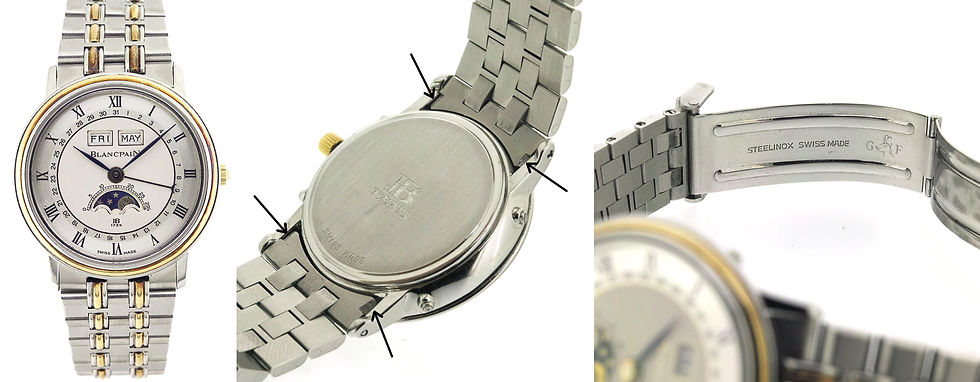
Another observation made with both earlier and later samples is that the clasp branding engravings are shown inconsistently between the bracelets. Some clasps are signed simply “JB 1735,” while others have a "JB 1735 with "Blancpain" branding below, with no strict chronological pattern. However, one detail does evolve consistently with close examination: the typography itself. Early bracelets with indentations in the end links that display a slightly larger, “JB 1735” + "Blancpain" engraving, while later bracelets observed in ref. 6595 adopt a smaller and tighter execution.

Around the ~650–700 serial range, a major transition appears to occur. The indentation in the end links begin disappearing in favor of a flatter bracelet integration that would become characteristic of later production. Initially, these flat end link bracelets still retained chamfered links, but later examples introduced a rounded-link refinement that appears more frequently in higher serial ranges and precious metal executions although it is also existent in all-steel. Interestingly, the rounded-link design never fully replaced the earlier chamfered style, suggesting both variants coexisted during the later years of production.

Perhaps the most surprising discovery is that bracelet evolution does not appear to be reference-specific. Late examples of the 6501 and 6511 share the same bracelet characteristics as the 6595, including flat end links, in some samples rounded links, and smaller “JB 1735” engravings. This could challenges the assumption that flat end link bracelets on 6501 and 6511 references are necessarily later service replacements. In many cases, they may instead represent factory-original late-production examples created during Blancpain’s broader transition toward more uniform manufacturing practices.
Conclusion
One important takeaway from the data I analyzed is that early 6501 and 6511 examples fitted with Gay Frères bracelets feature the characteristic indented end links, whereas later examples of these references as well as the 6595, transition to a flatter end-link construction, reflecting Blancpain’s gradual move toward a more standardized bracelet architecture during the revival era.
The 6501, 6511, and 6595 were not isolated chapters, but overlapping stages within Blancpain’s rebirth one where movements, bracelet construction, engraving techniques, and finishing details evolved gradually rather than all at once. More than forty years later, these small details continue to reveal just how dynamic and experimental the early revival era truly was.
Will the Gay Frères bracelets made for Blancpain’s Villeret line ever command the same prices as a Wellendorff bracelet? Perhaps not and honestly, that is not what matters most. What truly matters is that these bracelets are finally recognized for what they are: beautifully engineered creations born during one of the most fragile and fascinating periods in modern horological history. They deserve their proper place within the story of Blancpain’s revival and within the broader conversation surrounding great bracelet design.
And perhaps that raises an even more interesting question: should Blancpain bring these bracelets back for the modern Villeret collection? Personally, I would love to see it happen.
Special thanks to @liv.lif.lov and @alewatches for their assistance with my research!

Excellent article! Great research.
One of the most overlooked bracelet designs of the neo-vintage era.